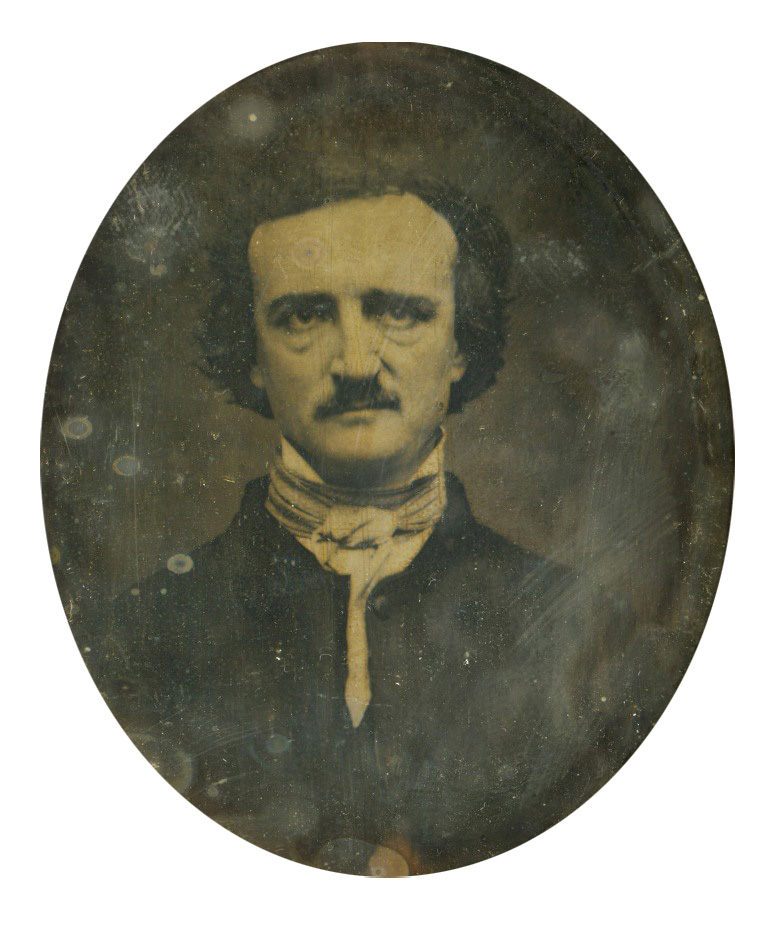
Edgar Poe was born in Boston on January 19, 1809, to the actors David and Eliza Poe. Orphaned before his third birthday, he was taken into the Richmond household of John and Frances Allan, though never formally adopted.
Education and first books
After years in Britain and Richmond, Poe entered the University of Virginia in 1826 but left amid financial conflict with John Allan. In Boston the following year, he enlisted in the U.S. Army under the name Edgar A. Perry and anonymously issued his first book, Tamerlane and Other Poems. A second collection followed in 1829. He entered West Point in 1830 and was dismissed in 1831 after deliberately neglecting his duties.
Editor, critic, and craftsman
Poe settled for a time in Baltimore with his aunt Maria Clemm and her daughter Virginia. His story “MS. Found in a Bottle” won a Baltimore literary prize in 1833, helping him secure editorial work at the Southern Literary Messenger in Richmond. He married Virginia Clemm in 1836.
Over the next decade he contributed to and edited several important magazines, including Burton’s Gentleman’s Magazine, Graham’s Magazine, and the Broadway Journal. His reviews could be severe, but his criticism argued consistently for precision, unity of effect, and high standards in American letters.
Recognition and final years
“The Raven,” published in January 1845, made Poe nationally famous, though fame did not bring lasting financial security. Virginia died of tuberculosis in January 1847. Poe continued to lecture and write, publishing the cosmological prose poem Eureka in 1848. He died in Baltimore on October 7, 1849, at age forty; the precise cause of his death remains uncertain.